
How I Wrote One Song
In which I answer Jeff Tweedy....

Jeff Tweedy’s book How To Write One Song (Dutton, 2020) is part of what I think of as a mini-cottage industry around songwriting. I say cottage industry because it’s not the thing itself (writing a song, in this case), it’s a thing that’s helping you do another thing. It’s like if songwriting were a salt or a gold mine, Tweedy’s book would be one of a row of hastily-erected clapboard shops on a dusty main street selling pickaxes, chisels, and camels to get your bounty back across the desert (or whatever it is you use to mine salt- sue me, I don’t know).
But I don’t mean to belittle Tweedy’s book by comparing it to some shady proprietor on Deadwood. In fact, I enjoyed it quite a lot, with one important reservation, and I’d recommend it to anyone- aspiring songwriters, certainly, but also to anyone who, like me, is fascinated with the creative process and always curious to learn about the approaches and methods used by different artists. In a way I’d put Tweedy’s book in a similar category to the Bauhaus artist Josef Albers’ Interaction of Color (Yale University Press, 1963), which was not really an instruction on creating art as much as it was a guideline to how Albers thought about the building blocks of his art. In Albers’ case, that was color, and specifically the way different colors interacted with the colors around them (I remember that he intriguingly compares color to music in this sense, pointing out that like a color, a note has no differentiation unless paired with another contrasting note). In Tweedy’s case, it’s the building blocks of a song- lyrics and melody.
My reservation about How to Write One Song wasn’t what I thought it would be when I started it. That would have been the obvious rejoinder for Tweedy’s songwriting prescriptions to dedicate a regular time each day for songwriting and for having a dedicated space in which to do it. As in, “that’s all well and good, Mr. Successful Rock Star with your own music studio and all the time in the world you could want, but what about the rest of us who are working a job (or two), raising a kid (or two or three) and just trying to squeeze in the time to be creative whenever and wherever we can?” But to Tweedy’s credit, he dispenses with this assumption early and often, aknowleadging that he’s been lucky and fortunate enough to be able to have a music studio and to treat songwriting as a job he makes time for every day. And I think his recommendations in this area- try and set aside even 15 minutes a day, anywhere you can with whatever you have- are eminently possible even for the most harried among us.
My reservation with the book, rather, was more philosophical than specific. It’s that I think there are as many ways to write a song as there are songs out there. Each one, in my view, is unique, and while I enjoy reading instructional books about songwriting, I’m really more interested in hearing anecdotes from songwriters about how they wrote specific songs of theirs (this is just me, of course, not necessarily you, because this is my Substack and not yours :) ). The Beatles Anthology has some of this; Paul’s The Lyrics has a lot of it; Recording the Beatles also fascinates me because it has a lot of this glimpse into the creative process but focused on recording techniques- which, being the Beatles is entirely appropriate since so much of their creative process was expressed in their recording techniques. And yes, there are non-Beatles related books that look at that creative process too (again, my Substack and not yours :)
With that in mind, I’m going to practice what I’m preaching here and take you through how I wrote one song of mine. Maybe this will interest you like it would interest me if you told me how you wrote a song of yours. The song is “What Would You Do If I Never Found Out,” which I wrote a few years ago and then recorded last year with my band, Bourbon Sprawl. I’m going to talk about this song not because I think it’s any great shakes or a classic by any means, though I am happy with how it turned out (which is not always the case!). Rather, it’s because for whatever reason I have an unusually clear memory of the exact moment I wrote it, and I also have recordings of the song at different steps along the way, so you can hear the process of its evolution, from the phone recording I made right when I wrote it through to the recording that appeared on Bourbon Sprawl’s last album, Hickster.
To set the scene, I need to talk about one songwriting technique I use that Tweedy doesn’t talk about in his book: joining songwriting contests and challenges. I am a sucker for these, because I am a deadline person. Ask any boss or close friend of mine and they will likely tell you the same thing- if you don’t give me a deadline when something needs to be done, good luck getting me to it. To be fair, Tweedy does talk about setting yourself an imaginary deadline to inspire yourself to create, which is essentially what these contests and challenges boil down to, for me anyway. I just prefer for these deadlines to be a little less imaginary, so I’ve joined ‘write 5 songs in 5 days’ challenges, and ‘write a song a week for the judges and see how many rounds you can get through’ contests, and several more. The biggest and best of these though, is FAWM. FAWM is an online challenge that happens every February wherein a couple thousand people from all over the world post newly written songs and comment on each other’s songs. The idea is to write 14 songs in 28 days, but, like all the other challenges and contests I’ve joined, there’s no real-world incentive to do this and certainly no consequences if you don’t. It’s more the extra motivation that comes with seeing a bunch of other people write a furious amount of songs, and not wanting to get left behind. Of course most of the songs I write there are terrible and I never follow up on them, but the point is that by forcing myself to create no matter what, my inner editor and critic gets turned down, simply because I don’t have time to listen to him or her. Eventually, without that nagging voice in my head saying “ugh, really? That’s the best you can do for that line? Why even bother finishing this?” I plow through and end up with a few songs I look back on and think, ‘huh, that’s actually not so bad!’
The upshot is that I tend to write a lot of songs in February, so it’s no surprise that looking back through my phone’s voice recordings, I see that I wrote “What Would You Do If I Never Found Out” on February 12, 2023. This was during a two-day stretch that I was able to spend by myself at my Dad’s old house in the Catskills, waking up, writing songs, eating, writing songs, sleeping, repeat (basically, what I imagine Jeff Tweedy’s whole life to be, though since he’s a human being that’s probably idealized and he probably has other stuff to do too). This recording is the first time I had played through the song all the way after writing it, or at least the first time I played through after pressing ‘record’ on my phone:
I remember standing by the wood stove in the living room with this riff in my head. It was driving and sort of bluesy, and all I knew for sure was that it was on the G string of the guitar. So I sat down at the table with my guitar and started trying to play it. As often happens, the riff my fingers played was different from the one I thought I was hearing in my head, but luckily I didn’t get bogged down in stopping and trying to figure out the notes I thought I was hearing. I just went with it and got a groove going, and started mumbling/singing, mostly around these long harmonies I could hear on “eeeee” sounds that I liked floating above the busier rhythm I was banging out on the guitar. I remember the line- ‘if you could get away with something I’d never seeeeeee’ came first out of the mumbled melodies I was stringing together. I wrote that down in my notebook, then started thinking about what it meant. I briefly started thinking this was a song about your lover cheating on you, and started brainstorming all these different images- an illicit hotel room, a secret text. But I quickly ditched that idea partly because everything I thought of seemed cliche and trite, but mostly because I felt the question- mysterious, open-ended, maybe a little titillating- was more interesting than the answer- specific, boring, so what?
So lyrically, I now had a road map and I started trying to fill it in. I started singing ‘what would you do if I never found out, if you knew that I’d never throw you out’ just to elaborate on the ‘if you could get away with something I’d never see’ line and liked it. The second verse seemed like it should dive into what these illicit activities could be, but I was still into the question aspect of the song and wanted only to hint at what any answers would be, so I wrote ‘maybe it’s something you ain’t thought of yet.’ Trying to go with a rhyme, I wrote down ‘like a child with a surprise pet’ but crossed it out- too specific. ‘A stolen moment you could never regret’ seemed appropriately vague, followed by filling in the lead up to another one of those ‘eeeee’ harmonies I was hearing- ‘just something that would never get back to me.’
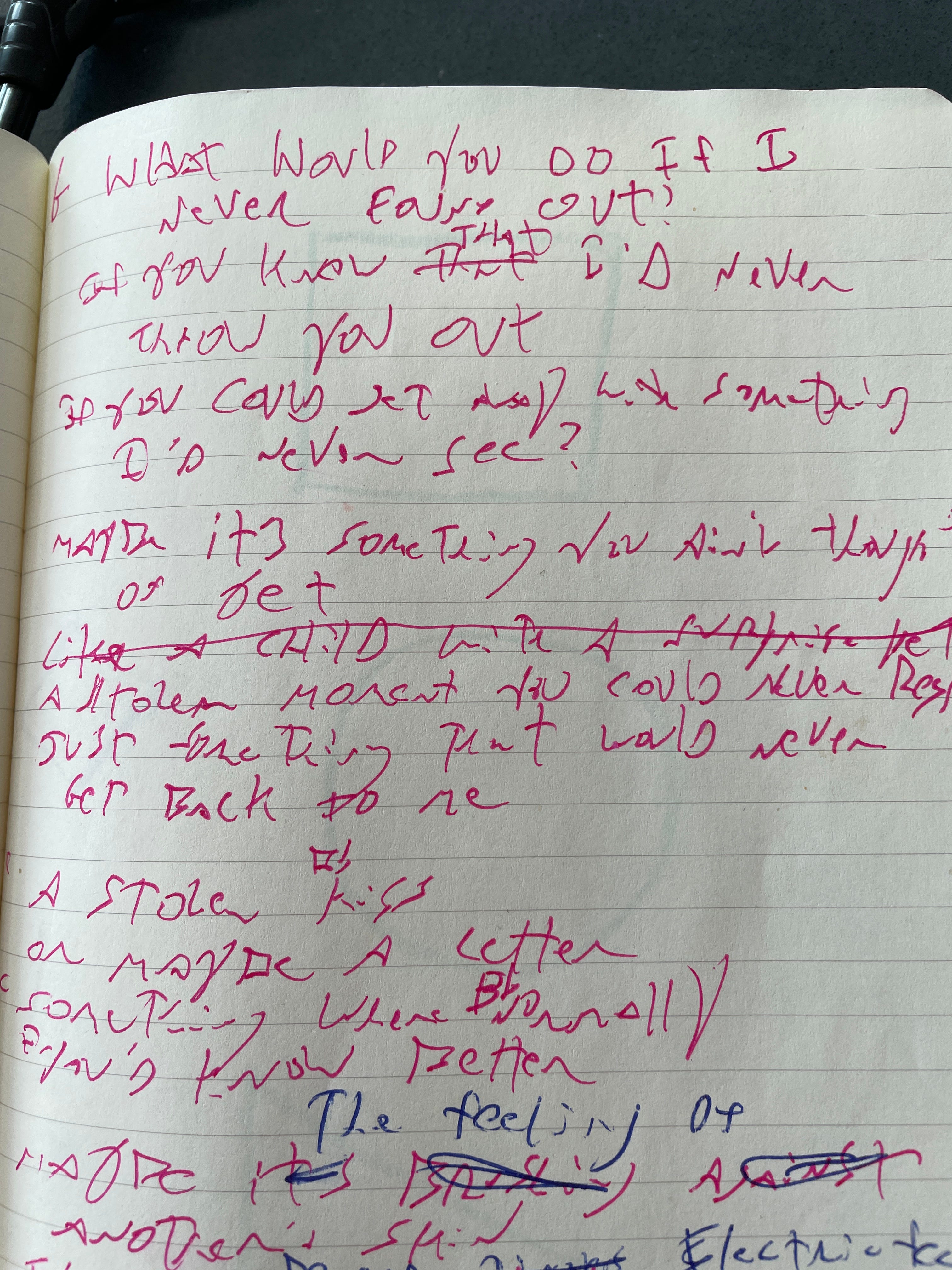
Then came the bridge. Now, I am not in the tribe of ‘every song needs a bridge’, or even, ‘every song needs a different part.’ I am firmly in the tribe of ‘anything can be a song,’ whether it has a million chord changes or none at all (on this Tweedy and I agree), and as proof I can point to any number of certifiably great, classic songs- from The Talking Heads “Once In A Lifetime” to War’s “Lowrider” to any John Lee Hooker’s “Boogie Chillun” or Muddy Water’s “Mannish Boy”- that needed nothing more than one great riff. But something about this song I was writing seemed like it needed a release, something that made the main section even stronger when it came back to it. So I started playing around with different combinations and pretty quickly settled on a C to Bb, the 4 to the minor 3rd, which seemed like a nice little detour that didn’t lose the momentum of the main riff. This seemed like a good time for some of those ideas about all the things we could be doing when we’re getting away with something, so ‘a stolen kiss or maybe a letter’ seemed to fit, and ‘something normally you’d know better’ underlined again the illicit and forbidden (and therefore exciting?) nature of whatever your answer would be.
Looking at the notebook pages from when I wrote the song, there’s very little crossed out, relatively speaking. Some songs of mine have entire pages X’d out, but on this one there’s really only a few lines. That dovetails with what I remember about writing it, which is that it all came out pretty quick. Maybe that was inspiration, plus the fact that I was in an intense period of creating a lot of songs really quickly. In any case, some of those crossed out lines are in the second verse, where I started going for different vowel sounds on those long ending harmonies and trying different ways of getting there. So, singing mostly nonsense and playing, I liked ending up on ‘ooooo’ and then ‘real’. So I started thinking about feelings that would get you to cheat on your partner and about that spark that feels like a high with a new person, which became “maybe it’s brushing against another’s skin, electric feeling when you just begin”, and then I started thinking about the gloss of memory, and how we romanticize things looking back on them, which came out “like those fantasies of loves gone by, always better in your head but you try, what if you could take one out and make it real?'“
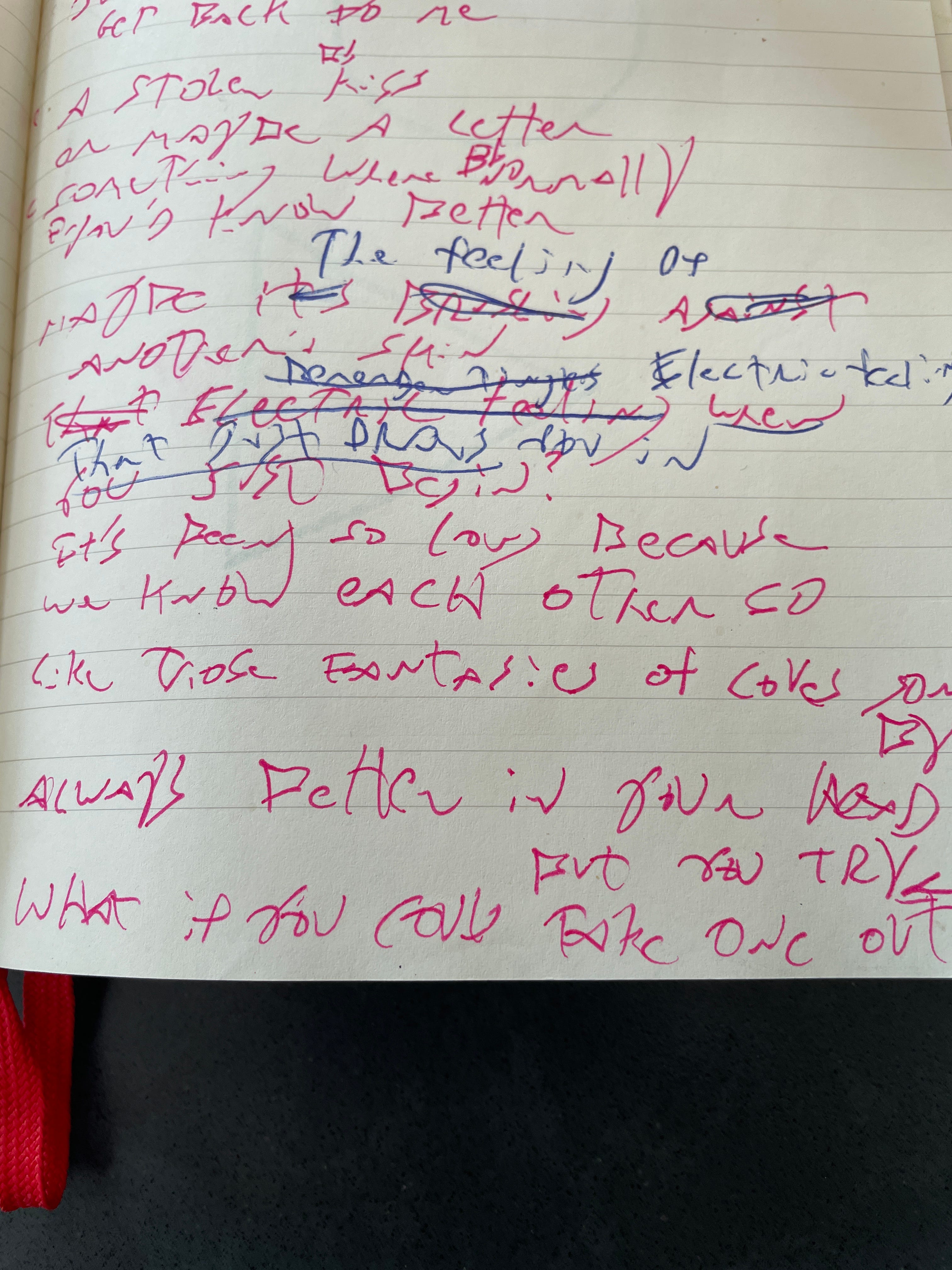
This seems like a good time to answer a question I’ve been asked a lot, especially about this song- is this you? Or rather, is this you and your wife?? The short answer is, no. The longer answer is, no….except kinda sorta maybe the emotions, in a way, but really, no.
What I mean is- I write in character a lot. But I firmly believe that to write any kind of decent song you have to have some kind of empathy (Elon would be a terrible songwriter). Even if you’re writing a purely confessional, personal song, you need empathy for the emotions in it and how those emotions translate to anyone listening to your song, otherwise it won’t connect with anyone. When I write in character (which is often), those characters are not me, but in the songs I end up happy with, there’s some aspect of their emotions that is me because I can relate to it. For instance, I once wrote a song called “Ride” from the point of view of a guy who had just blown up NYC’s power grid and was speeding away from the cops on the FDR Drive. Spoiler alert for those who don’t know me: I have never done this. I have no plans to ever do this. But, do I empathize with this character’s desire to ‘unplug,’ to experience life without the constant background hum of technology? Absolutely, which is the emotion that song came from. I wrote another song called “Little Black Book,” which was about a meter maid who was lonely and frustrated with her (or his) career as a writer, not realizing she (or he) would reach their goal of being a “pillar of community” by writing parking tickets, but being somehow satisfied with it nonetheless. Again, I have never been a meter maid and have no desire to ever be one. But I know how it feels to want to be a part of a larger community and to play a role in it, whatever that role is, and that’s where that song came from.
When I wrote “What Would You Do,” I remember that, in my head at least, it was coming from the point of view of another character. This was someone, woman or man, who was saying to their partner, hey, I know what it’s like to remember that rush of a new relationship, I know what it’s like to be curious about another’s touch, why don’t you just open up and share that feeling with me? And more broadly, why don’t you just tell me your real desires? And like probably just about every other human who’s ever had a relationship with another human, I can empathize with that.
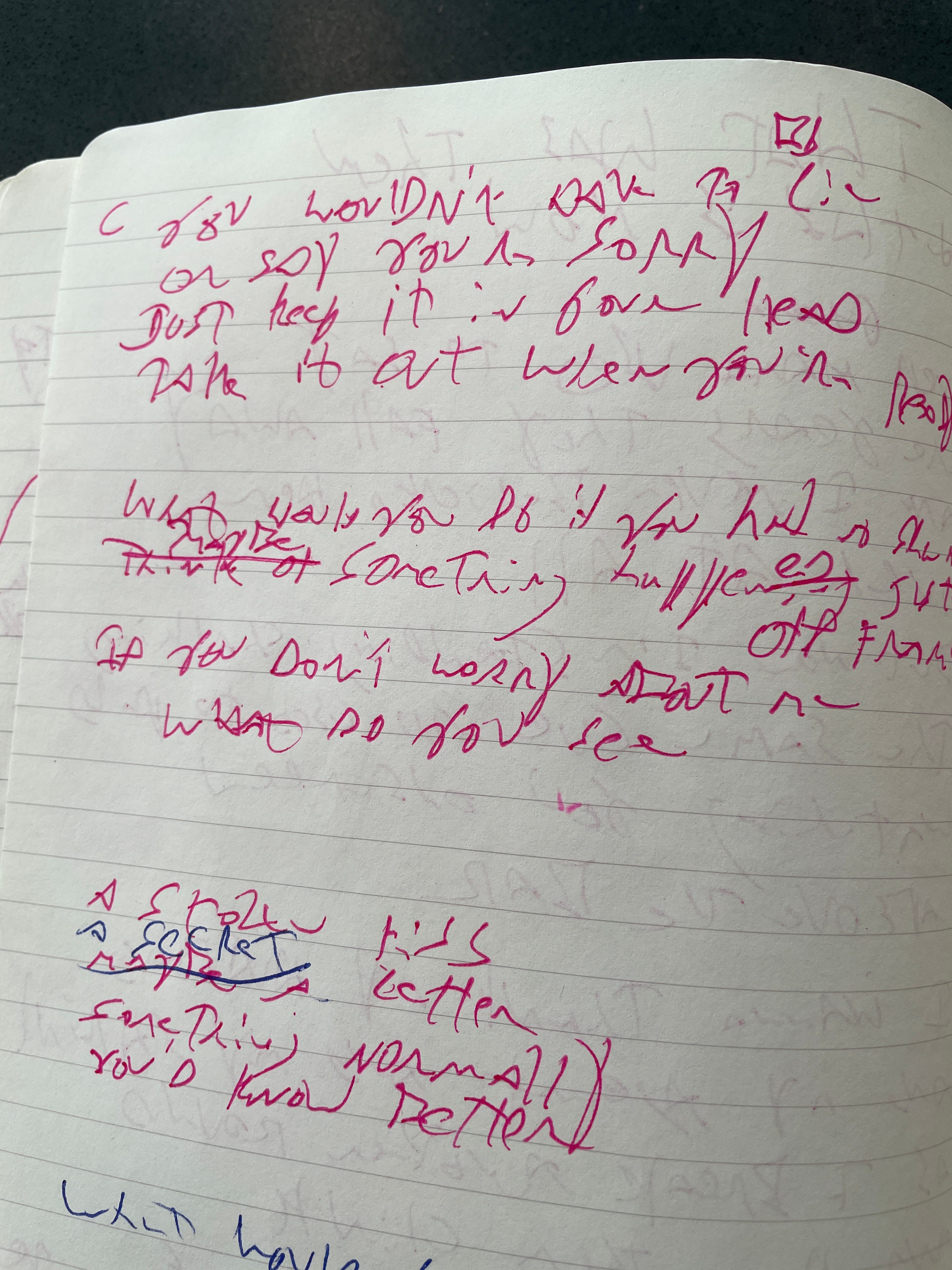
All of which is a long-winded way of explaining what the core of this song is about. At the time, I wasn’t thinking about any of that. At this moment after that verse, I was just thinking it was time for another bridge section, which I wanted to be different than the first (and then I think I already knew I wanted to come back to the first one once more in the song). So, answering that last sentiment of ‘what if you could take a fantasy out and make it real’, I landed on “you wouldn’t have to lie, or say you’re sorry, just keep it in your head, take it out when you’re ready.” Then I felt like it would be time for an epic, cathartic solo or riff of some sort (which I lamely approximated on my first phone recording), and then I envisioned a chilled-out section similar to my favorite section in every Van Halen song- the part where the band calms down after another blistering Eddie solo and Diamond Dave sort of half-sings-half-talks while the band builds up again. For this I felt like a return to the original question of the song but put in a different way, so that became “what would you do if you had no shame, something happened to you just off frame, when you don’t worry about me what do you see?” Looking back at this song now, somehow those last lines have always resonated with me the most. I know the song has sexual overtones- it’s hard not to hear it as one lover telling another to go ahead and cheat on them- but to me the core of it is someone saying, ‘forget about feeling guilty or about what you think you’re not supposed to do and just tell me what you want to do.’
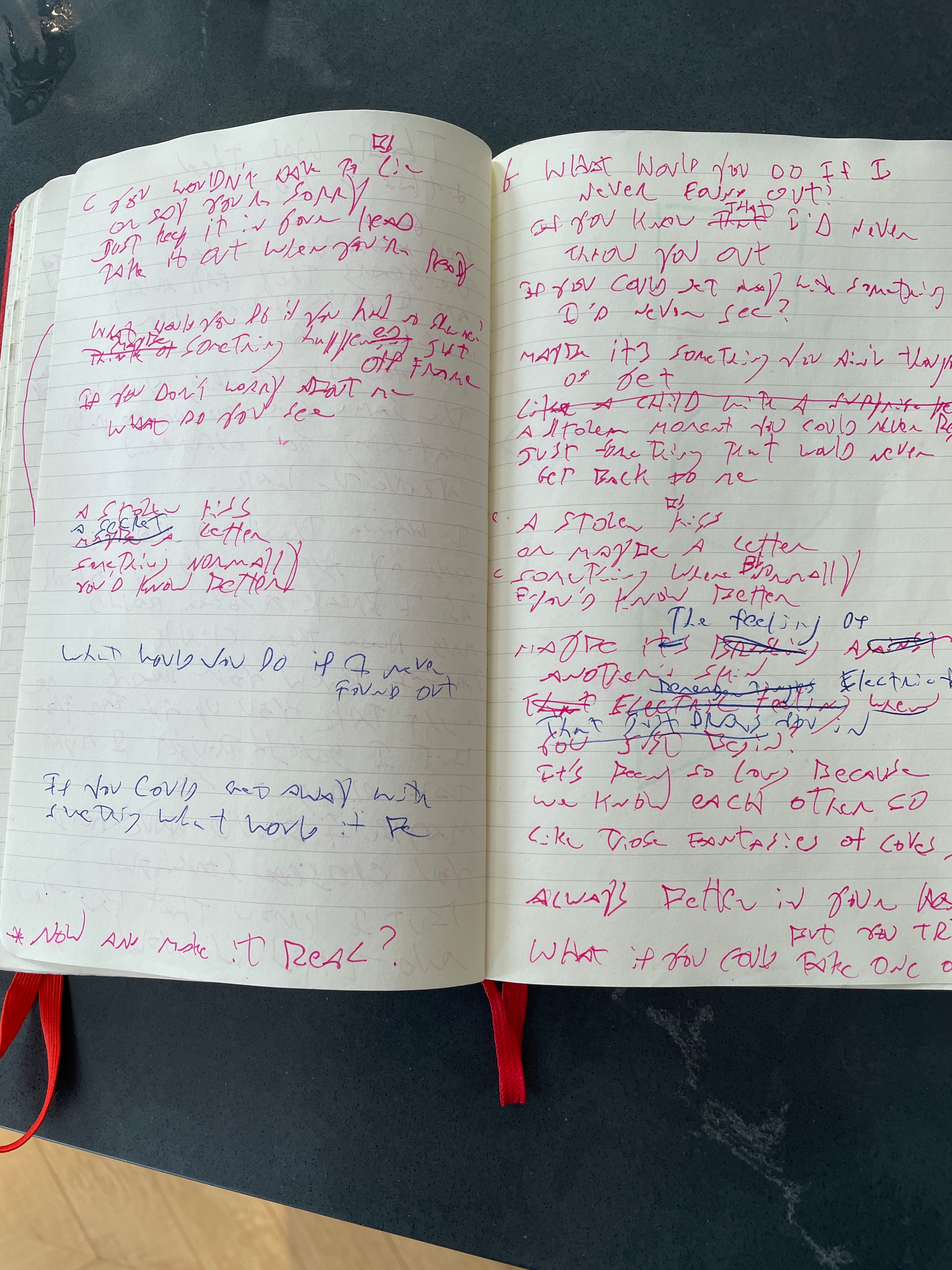
After that, I felt the song was basically done. I restated the three question lines from the first verse at the end, turned the recording app on on my phone, and played it all the way through.
And then the question is, then what? What happens to songs once you write them? Well, as far as this song goes- nothing, for quite a while. I remember I took a walk after I finished this song, hiking up to Bear Cliff in the cold February air, scrambling up to a rock outcropping to look out on the Catskill mountains, the sound of this song still knocking around in my head. Then I got back home and, at least according to my recording app, wrote two more songs that day, the process of which I really don’t remember much at all, certainly not like I remember this one.
And then nothing really happened with this song. I didn’t show it to my band, Bourbon Sprawl, because I thought we were a country band and this wasn’t a country song. So it just sat there in my head and on my phone and in my notebook. And then about a year later something made me take it out and show it to the band after all. I’m pretty sure this recording is the very first time we played it, you can hear me teaching the riff to the band in the beginning:
For me, listening to this recording is bittersweet because you can hear our pedal steel player Jon Light, who died in January 2025, so prominently. That’s him at the end telling us he’s happy to just create a vibe and doesn’t need to solo, which was exactly the kind of thing that made him such a wonderful musician and person.
As you can hear, it’s pretty rough, as first takes by a band of a song often are. There’s always a bit of nerves too, at least on my part, in seeing a song make the journey from such a private expression, sitting alone with my guitar at a table, to trying to communicate the feeling of it to other musicians so that we can translate and communicate it to more people after that. A month of so later, we had tightened it up a little:
This last rehearsal recording may have been right before we played the song in public for the first time, or right after, I don’t remember. I remember that first time we played it (at The Station, in Woodstock, NY), it went well, people danced to it and seemed to like it, and it soon found its way into our live sets. Fast forward a little less than a year after that, and we recorded it ‘for real’ at our drummer Bram’s studio and released it on our album, Hickster:
It’s nice that this conglomerate of music, words and emotion that I hammered out that day by myself has made the journey out to the wider world- most songs of mine certainly don’t. Which is also ok. One thing I liked about Tweedy’s book is that he underlines that the process is the goal, that he enjoys the process of songwriting more than anything, and that he thinks the most important thing in being a songwriter is not to be successful or have your songs on the radio or whatever, but to enjoy this process of writing songs more than you do anything else in the world. I may be embellishing his actual words there, but anyway I wholeheartedly agree. Hopefully, if you’ve read this far, you’ve at least found this glimpse into my creative process a little interesting, whether you write your own songs or not. Let me know!